

Board minutes are a legal requirement, and often the first document anyone asks for if a decision is ever challenged. Yet minute-taking is consistently rated one of the biggest pain points for boards. It’s labour intensive and more often than not, there's no clear structure to work from meaning you have to reinvent the wheel every meeting.
This guide covers what UK law requires in board minutes, what good minutes look like, and a free meeting minutes template to get your started.
How to Write Board Meeting Minutes (Step by Step)
Good minutes come down to structure, not writing skill. When you follow the same process every time and drafting minutes can be significantly more efficient and you're more likely to accurately capture the important action items.
1. Prepare beforehand
Have the agenda, prior minutes, and template ready before the meeting starts. Decide the format in advance rather than inventing it live.
2. Confirm quorum and attendance
Record who's present, apologies, and confirm quorum against your Articles. A decision made without confirmed quorum can be challenged later.
3. Always record declarations of interest
Ask every meeting, even when the answer is none. "None declared" is a documented statement; silence isn't.
4. Capture decisions and reasoning, not discussion
Minutes aren't a transcript. Record what was decided and why, plus any dissent, not who said what.
5. Assign owners and deadlines
Every action needs a named owner and a date. Vague ownership is the most common reason follow-up doesn't happen.
6. Stay neutral and consistent
Record outcomes, not tone. The same structure every time makes minutes faster to write and easier to search later.
7. Circulate within 3–5 working days
Get the draft out while it's fresh, so corrections happen early rather than at the next meeting.
8. Approve and retain
Minutes are adopted at the next meeting, then kept for at least 10 years under the Companies Act 2006.
Get BoardPro's free board meeting minutes template
A ready-made framework covering meeting details, decisions, actions and an interest register, a solid starting point whether or not you're using board software day to day.
Download the Meeting Minutes Template →
Key takeaways
- Minutes aren't optional admin, under the Companies Act 2006 (section 248), UK companies must keep records of board decisions, retained for at least 10 years.
- Charities aren't bound by section 248 in the same way, but the Charity Commission expects trustees to keep accurate minutes evidencing decisions made in the charity's best interests.
- BoardPro's own research into governance pain points found that 76% of respondents rated minute-taking a significant challenge, usually a structure problem, not a writing one.
- This guide covers what UK minutes should include, worked examples, and where to get a free template.
What are board meeting minutes, and why do they matter?
Board minutes are the formal written record of a board meeting, what was discussed, what was decided, and what happens next. They're not a transcript. Done well, they're concise: capturing decisions, the reasoning behind them, and who's responsible for follow-up, without recording every word said.
Minutes matter for reasons beyond good record-keeping. They're often the first document requested if a decision is ever challenged, and they're the clearest evidence that directors or trustees exercised proper care in reaching a decision, not just that a decision was made, but that it was made properly.
.png?width=1141&height=760&name=Board%20meeting%20minutes%20template%20(1).png)
UK legal requirements for board minutes
Limited companies
Under the Companies Act 2006 (section 248), companies must keep minutes of all board meetings. They must be retained for at least 10 years, and kept at the company's registered office or in a form accessible electronically.
Directors can be held personally liable for records that are missing or misleading, so this isn't just best practice, it's a legal obligation that applies regardless of company size.
Charities and trustee boards
Charities aren't subject to section 248 in the same way limited companies are, but the Charity Commission expects trustees to maintain accurate minutes that show decisions were made in the charity's best interests.
The Charity Governance Code reinforces this, minutes are typically the clearest evidence a charity has that its trustees are meeting their duties, particularly around conflicts of interest and financial decisions.
What this means in practice
Whichever category your organisation falls into, minutes should at minimum record:
- the date, time and location of the meeting
- who attended and any apologies
- confirmation of quorum
- declarations of interest
- the substance of key discussions and decisions
- resolutions passed
- actions assigned with owners and deadlines
- and the time the meeting closed
Minute template examples
Example: limited company
|
[Company Name] Ltd, Board Meeting Minutes Date: [date] Time: [start–end] Location: [venue/video link] Present: [Chair], [Directors] Apologies: [names, or none]
1. Quorum confirmed per the Articles of Association. 2. Minutes of the previous meeting (dd/mm/yyyy) approved. 3. Financial report: [Name] presented Q[X] figures. The board approved [decision, e.g. a revised budget allocation of £X for Y]. 4. [New business item]: [Name] proposed [X]. Board requested [further information / voted to approve], carried [unanimously / X in favour]. 5. Date of next meeting: [date]. Meeting closed: [time] |
Example: charity trustee meeting
|
[Charity Name] (Charity No. [XXXXXX]), Trustee Meeting Minutes Date: [date] Time: [start–end] Venue: [in person / video platform] Trustees present: [names] Apologies: [names]
1. Welcome and apologies noted. 2. Declarations of interest: [none declared / Trustee X declared an interest in item Y and withdrew from that discussion]. 3. [Policy/safeguarding item]: [decision]. Action: [Name] to [next step] by [date]. 4. [Programme/finance update]: [Name] presented [update]. Trustees agreed [decision]. 5. Any Other Business: [item, or none raised]. Meeting closed: [time] |
Minute-taking best practice
- Stick to decisions and key points. Not a verbatim transcript, focus on what was decided and why, not everything that was said along the way.
- Always name who's responsible. Every action needs an owner and, ideally, a deadline, vague ownership is one of the most common reasons actions don't get done.
- Keep it neutral. Record outcomes and reasoning, not personal opinion or how a discussion felt.
- Circulate quickly. Draft minutes within 3–5 working days while the discussion is still fresh, so corrections happen early rather than at the next meeting.
- Use the same structure every time. Consistency makes minutes faster to write, easier to review, and simpler to search later.
Common mistakes that undermine compliance
- Missing quorum confirmation, a decision made without quorum can be challenged later.
- Declarations of interest not recorded, even when none were raised, silence isn't the same as a documented 'none declared.'
- Vague or unattributed actions with no owner or deadline.
- Minutes stored in personal inboxes or unsecured shared drives rather than a permanent, accessible record.
Download the free template
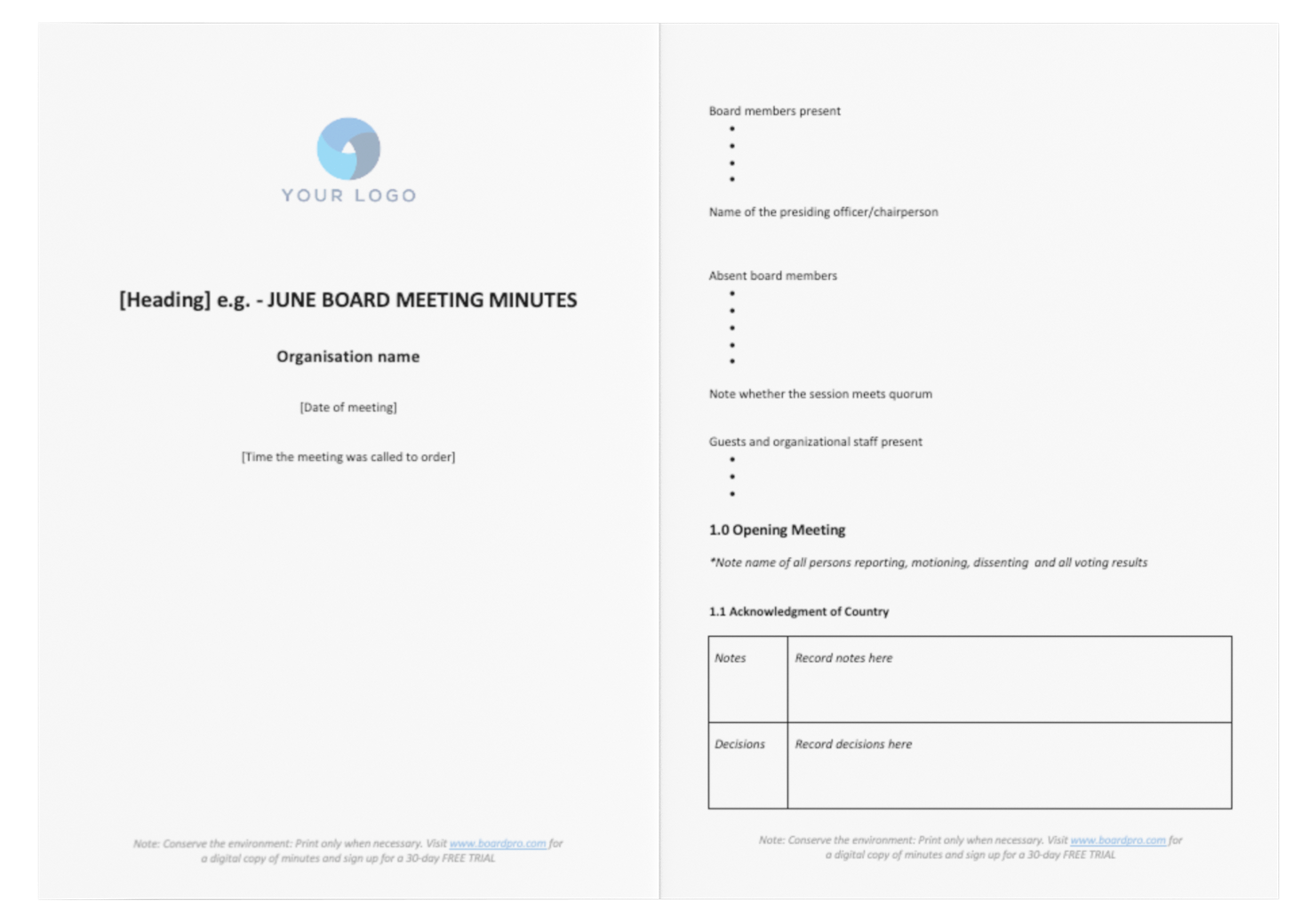
BoardPro has a free, downloadable board meeting minutes template and guide, covering meeting details, an interests register, an action register, and space for strategic discussion, a solid starting point whether or not you're using board software day to day.
Download the Meeting Minutes Template →
Take the admin out of minute-taking with BoardPro
A template gives you the structure, but someone still has to chase the notes, format them, and get them circulated before anyone forgets what was agreed. That's usually where minute-taking actually falls down, not the writing itself.
BoardPro's Minutes feature builds the record as the meeting happens: agenda items, decisions and actions flow straight into the minutes automatically, so there's no separate write-up from scratch afterwards. Declarations of interest and actions are captured against the right item, and the finished minutes are ready to review and circulate the same day, not five working days later.
Stop reconstructing minutes from memory after every meeting.
Try BoardPro free today.

Frequently asked questions
How long must UK companies keep board meeting minutes?
At least 10 years, under section 248 of the Companies Act 2006, kept at the registered office or in an accessible electronic form.
Do charities have the same legal requirement to keep minutes as companies?
Not under section 248 specifically, but the Charity Commission expects trustees to keep accurate minutes as evidence that decisions were made in the charity's best interests, in practice, the standard expected is similarly high.
Who is responsible for taking board minutes?
Usually the company secretary where one is appointed; in smaller companies or charities, this often falls to a director, trustee, or an executive assistant supporting the board.
Should minutes record how each director voted?
Only where relevant, record resolutions clearly and note any dissent or declared conflicts, but there's no general requirement to record how every individual voted on every item.
Share this

Board Meeting Agenda Template + Best Practice
.jpg)
5 Best Board Management Software for UK Directors