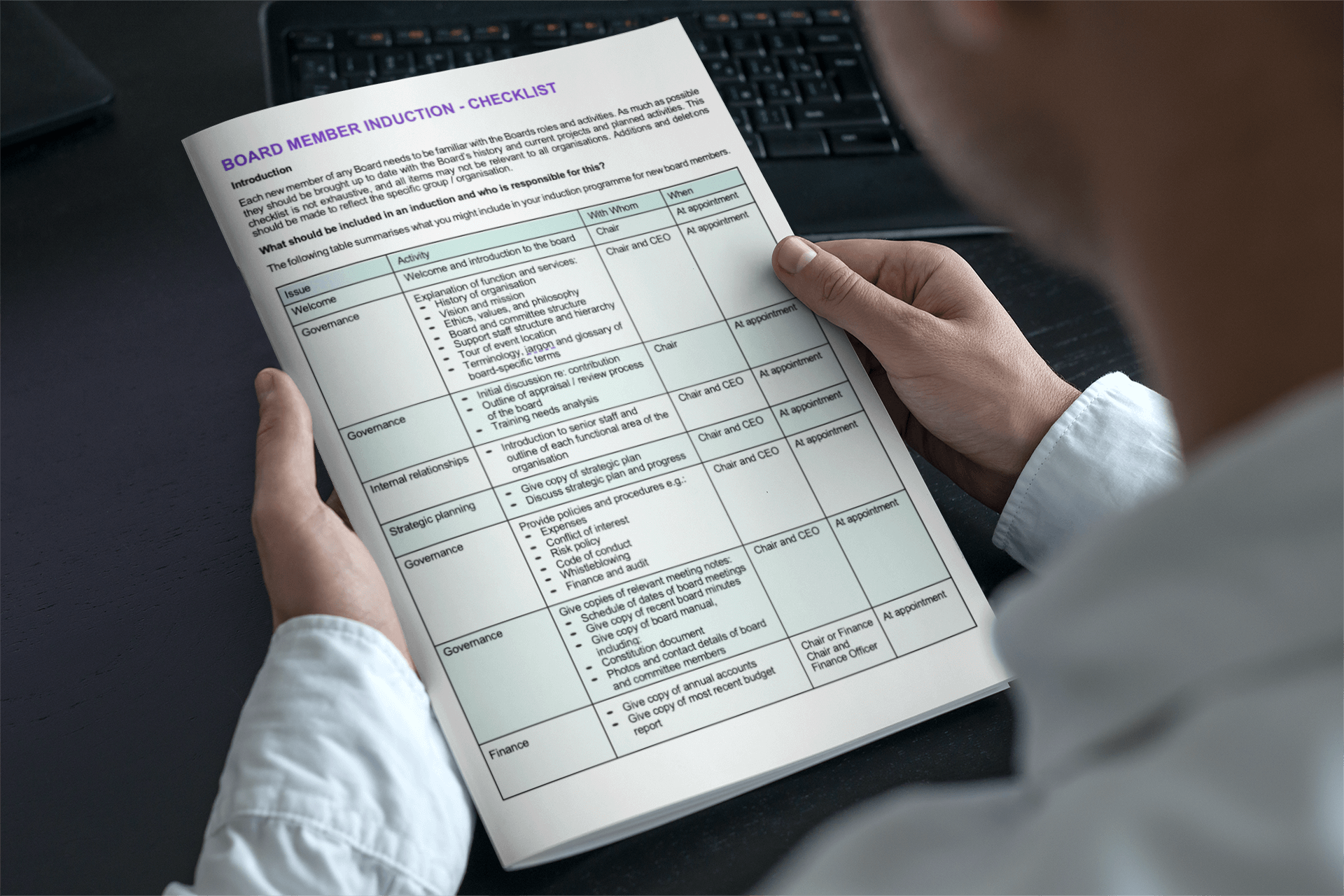
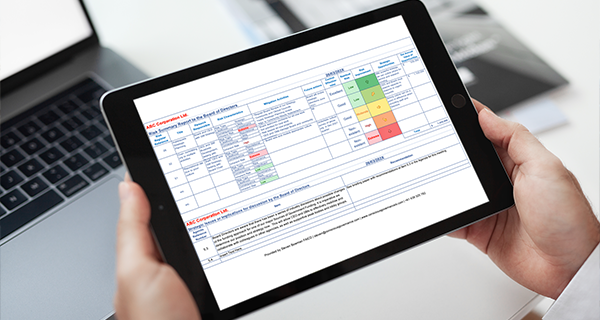
A board paper is the document that asks the board to do something: note, discuss, or decide. Get it right and the board meeting runs smoothly. Get it wrong and you waste expensive director time on questions that should have been answered before anyone sat down.
This guide explains what makes a great board paper, walks through every section you need, and gives you a free board paper template to download and use immediately. If you're building a board pack, the full set of papers distributed ahead of a meeting, this is the foundation.
Download the free board paper template
A ready-to-use Word template covering every section in this guide, with a standard cover sheet and risk table built in.
Download the BoardPro board paper template →
What is a board paper?
A board paper (sometimes called a board report or board submission) is a formal document prepared by management and submitted to the board for consideration at a board meeting. Each paper covers a single agenda item and typically asks the board to:
- Note, acknowledge information without taking action
- Discuss, deliberate on an issue without a formal resolution
- Decide, pass a resolution, approve expenditure, or authorise an action
Board papers are collected into a board pack and distributed to directors in advance of the meeting, typically five to seven days beforehand. The quality of your board papers determines the quality of your board's decisions.
Why board paper quality matters more than you think
Poor board papers don't just make meetings longer, they create governance risk.
When directors can't quickly find the recommendation, they make decisions without full context. When the financial implications are buried in paragraph six, someone misses them. When risk isn't explicitly addressed, the board assumes it's been managed.
A well-structured board paper:
- Gets directors to the recommendation faster
- Surfaces risks and financial implications clearly
- Creates a clean record for audit, regulatory review, or future reference
- Reduces back-and-forth between management and the board before meetings
For UK companies, this matters in regulatory terms too. Under the Companies Act 2006, directors must exercise reasonable care, skill and diligence. Poorly drafted board papers that obscure material information make that standard harder to meet.
Board paper vs board pack: what's the difference?
Board paper: a single document covering one agenda item.
Board pack: the full collection of board papers, minutes from the last meeting, standing reports (CEO report, financial dashboard, risk register update), and any supporting documents, distributed to directors ahead of the meeting.
Most boards have a standard board pack structure. Individual board papers sit within that structure and must conform to whatever template the organisation has established.
Two of the most important standing reports in that pack are the CEO report and the risk register summary.
The standard board paper structure
Below is the template structure used by well-governed UK organisations. Sections may vary by organisation, but the core elements are consistent.
1. Cover information
- Paper title, clear, descriptive, with action type in brackets: e.g. Q2 Budget Variance Report [For Note]
- Agenda item number
- Prepared by, name and title of the author
- Sponsor, the executive taking accountability for the paper
- Date
2. Executive summary / recommendation
This is the most-read section. Write it last, but put it first.
State the proposed resolution in plain English: what you're asking the board to approve, note, or decide, and why now. Should be no longer than half a page. Directors may read only this section in full, it must stand alone.
3. Purpose and background
- Why is this paper being presented at this meeting?
- What prior board decisions or context is relevant?
- What external advice or third-party information has been relied upon?
Keep to one page. Non-executive directors often come from outside the organisation; assume they know the company but not the specific issue.
4. Analysis and options considered
- What options did management evaluate?
- What criteria were used to assess them?
- Why is the recommended option preferred?
Use tables or simple scoring matrices where the decision involves multiple competing options. Don't just present the preferred option, show the thinking.
5. Financial implications
- What does this cost? Is it budgeted?
- What is the impact on cash flow?
- If a business case exists, summarise NPV, payback period, and key assumptions
- Does this require external financing?
Financial implications are frequently the most important section for the board and the most under-written in practice. Be specific about numbers.
6. Risk analysis
A summary risk table showing the major risks, their likelihood, potential impact, and proposed mitigation. Boards increasingly expect this as a standalone section, not buried in the analysis.
|
Risk
|
Likelihood
|
Impact
|
Mitigation
|
|
Planning approval delayed
|
Medium
|
High
|
Parallel planning pre-application submitted
|
|
Cost overrun
|
Low
|
Medium
|
Fixed-price contract with penalty clauses
|
For risks that recur across papers and meetings, this section should cross-reference the organisation's risk register rather than restating it from scratch.
7. Strategic alignment
How does this proposal support the organisation's agreed strategy? Reference specific strategic priorities by name. If it doesn't align, say why the exception is justified.
8. Legal and compliance
Relevant legislation, regulatory requirements, contractual obligations. Flag if legal counsel has been obtained.
9. Recommendation
The exact proposed resolution, written in the form it will appear in the minutes. This should be a clean, unambiguous statement of what the board is being asked to approve.
10. Appendices
Supporting documents, financial models, legal opinions. Number them sequentially and reference in the body of the paper.
Common board paper mistakes (and how to fix them)
1. The recommendation is buried
Fix: move it to the executive summary. Always.
2. Too long
Fix: most board papers should be two to four pages. Supporting detail goes in appendices. If a director needs to read 15 pages to understand your recommendation, the paper isn't doing its job.
3. No clear ask
Fix: every paper must have an explicit action, note, discuss, or decide. Papers without a clear action waste board time.
4. Financial implications missing or vague
Fix: if it costs money, say how much, whether it's budgeted, and when it will be spent. “Minor financial implications” is not acceptable.
5. Risk not addressed
Fix: add a risk section as standard. Even if risk is low, saying so explicitly is better than silence.
6. Written for the author, not the reader
Fix: non-executive directors are smart generalists, not specialists in your function. Write for an intelligent outsider who doesn't know the background.
Board paper template download
BoardPro provides a free board paper template designed for UK boards, available in Word format. The template includes all sections above with guidance notes for each, a standard cover sheet, and a risk table. It's ready to use immediately or adapt to your organisation's house style.
Download the board paper template
Free to download, in Word format, with a standard cover sheet and risk table built in.
Download the BoardPro board paper template →
From template to automated: how BoardPro changes the process
Managing board papers in Word and email creates problems that compound over time:
- Multiple versions circulating simultaneously
- Directors accessing outdated papers
- No audit trail for changes
- No central record of decisions and actions
BoardPro replaces the email-and-attachment workflow with a purpose-built board management platform. Papers are uploaded once, access is controlled, and the board pack is distributed digitally. Directors annotate papers on any device. Minutes and actions are tracked automatically.
The result: less time managing logistics, more time governing. UK boards using BoardPro typically save three to five hours of administrative time per board cycle, time that goes back into the work that matters.
The chair's job in running that meeting well is covered in our guide to how to chair a meeting effectively.
Summary
A good board paper has a clear recommendation upfront, addresses financial implications and risk explicitly, and is written for the reader rather than the author. The template above gives you the structure. BoardPro gives you the platform to manage the whole cycle, from paper creation to distribution to minutes.
Start a free trial of BoardPro
See how board papers, packs, and minutes work together in one platform.
Start a free trial →
Related guides