The CEO's report to the board is one of the most important documents in the governance cycle. Done well, it keeps the board informed, focused, and able to provide genuine oversight. Done badly, too long, too operational, or chronically late, it wastes board time and creates governance blind spots.
This guide explains what a strong CEO board report should contain, how to structure it, and what common mistakes to avoid. There's a free template to download at the end.
Download the free CEO report template
A ready-to-use Word template covering every section in this guide, with guidance notes and editable RAG status fields.
Download the free CEO report template →
What is a CEO report?
The CEO report (also called the chief executive's report or executive director's report for charities) is a standing paper submitted by the CEO to the board at each meeting. Unlike specific board papers, which address individual decisions, the CEO report provides a regular update on:
- Organisational performance against strategy and KPIs
- Key operational developments since the last meeting
- Financial position overview
- People and culture highlights
- Emerging risks and issues
- Strategic horizon, upcoming decisions or opportunities
The CEO report is not an exhaustive operations manual. It is an honest, forward-looking summary that equips non-executive directors to discharge their oversight role.
For more on what that oversight role actually involves, see our guide to the responsibilities of a non-executive director.
When do you need a CEO report?
Every organisation with a board, whether a private company, a charity, or a subsidiary reporting to a parent board, needs some form of regular CEO update. The format and frequency vary by context, but the underlying requirement does not: the board cannot exercise oversight without a regular, honest account of organisational performance from the person running the organisation day to day.
For companies, the CEO report typically accompanies each scheduled board meeting (quarterly for most SMEs, monthly for high-growth or higher-risk businesses). It sits alongside, not instead of, the management accounts.
For charities, the equivalent is usually called the chief executive's or executive director's report, submitted to trustees at each board meeting. It carries particular weight in the charity context because trustees, who are often part-time and non-specialist, rely on it heavily to understand operational reality. Charity-specific considerations include:
- Beneficiary impact, not just financial performance, needs a visible place in the report
- Funding and grant dependency should be flagged explicitly, particularly where a major funding relationship is time-limited
- Safeguarding updates, where relevant, should be a standing item, not folded into general operational commentary
- The report should support, not duplicate, the trustees' annual report and the risk management statement required for charities with income over £500,000
A subsidiary or division reporting into a parent board needs a leaner version: the parent board usually wants strategic and financial headlines rather than full operational detail, since governance of day-to-day matters typically sits with the subsidiary's own management.
Why CEO reports go wrong
Most CEO reports fail for one of four reasons.
Too operational. The CEO reports in detail on activity rather than performance. Directors learn what the team has been doing, not whether it's working.
No red flags. The CEO reports uniformly good news, or buries problems in footnotes. The board's job is oversight; they can only do it if the report is honest.
Too long. A five-page CEO report that covers everything is less useful than a two-page report that surfaces what matters.
Disconnected from strategy. Individual items aren't linked to strategic priorities, so the board can't assess whether the organisation is making progress.
A well-designed CEO report template solves all four of these problems by giving the report structure, keeping the operational detail in annexes, and requiring the CEO to flag risks and issues explicitly.
CEO report structure: section by section
1. Executive summary
One page maximum. Cover:
- Overall RAG status: Red / Amber / Green
- Three to five key headlines from the period
- One or two items requiring board attention or decision
This section should be readable in 90 seconds. Many directors read only this.
2. Strategic progress
Progress against the organisation's top-line strategic objectives. Not an activity list, an assessment of whether you're on track, and why or why not.
|
Strategic priority
|
Status
|
Commentary
|
|
Grow UK market share to 15% by FY26
|
Amber
|
Pipeline strong but conversion lagging; see Section 4
|
|
Launch NFP tier
|
Green
|
Beta cohort on track; full launch Q3
|
3. Performance dashboard
Key metrics against target. Keep to six to ten metrics the board has agreed are the right leading and lagging indicators. Include trend direction (up, down, or flat versus last period).
For UK companies: revenue, gross margin, cash, headcount, and one or two sector-specific KPIs. For charities: income by source, expenditure versus budget, beneficiary reach, and any regulatory compliance metrics.
Resist the temptation to include every metric tracked by the business. The board dashboard should be different from the management dashboard.
4. Financial summary
A brief commentary on financial position, not a full P&L, which sits in the separate management accounts board paper. Cover:
- Revenue and expenditure performance versus budget
- Cash position and cash flow outlook
- Any significant variances requiring explanation
- Forecast versus budget for the full year
One page or less. Flag if there are items the audit or finance committee has already reviewed.
5. Key operational developments
The three to five most significant things that happened since the last board meeting. Not an activity log. Focus on things with strategic or financial significance, or things the board should know for governance purposes.
6. People and culture
- Headcount changes (significant hires, departures)
- Any significant people issues (employment tribunal risk, key person dependency changes)
- Culture or engagement highlights (pulse survey results, significant team achievements)
Boards often under-invest attention here. People risk is frequently the most significant unmonitored risk in smaller organisations.
7. Risks and issues
Risks: any new strategic risks identified since the last meeting, or changes in the status of existing registered risks. Cross-reference the risk register.
Issues: problems that are active and require either board awareness or board action. Be explicit, don't bury issues in narrative.
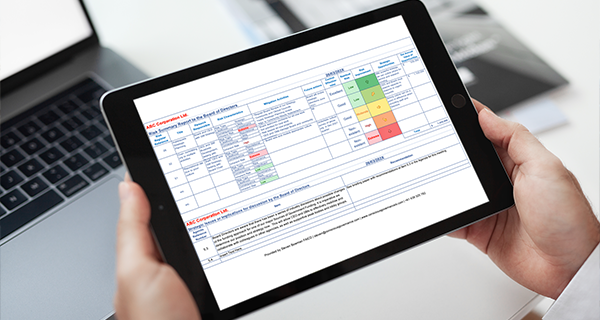
This section should never be empty. If there are genuinely no risks or issues to report, say so explicitly. Regular “no significant issues” reporting followed by a sudden risk escalation destroys board confidence.
For a full framework on capturing and scoring risk consistently, see our risk register template for UK boards.
8. Horizon
What's coming up that the board should know about? Upcoming decisions, regulatory deadlines, market developments, planned announcements. Typically three to six items.
9. Items for next meeting
A forward agenda prompt: what board papers will be submitted at the next meeting, and what pre-reads or decisions are required. Helps the board prepare and prevents last-minute paper submissions.
Formatting principles
Length: aim for two to four pages for the core report. Supporting data goes in annexes.
RAG ratings: use them consistently. Red means a material issue requiring board attention. Amber means a developing issue being managed. Green means on track. Avoid using amber as a default to avoid scrutiny.
Language: write for a non-executive director who knows the organisation but not the operational detail. Avoid jargon; explain acronyms on first use.
Frequency: submitted for every board meeting (typically quarterly, sometimes monthly for high-growth or higher-risk organisations). Submitted alongside, not instead of, management accounts.
Timing: circulated with the full board pack, no later than five working days before the meeting, consistent with the standard the rest of the pack should meet.
See our guide to building better board packs for that wider standard.
The chair's perspective: what good looks like
A well-run board appreciates a CEO report that:
- Starts with what matters most, not what's easiest to report
- Explicitly distinguishes between what's going well and what isn't
- Gives the board enough context to ask useful questions, not so much detail they can't see the wood for the trees
- Is consistent, same structure every meeting, so directors know where to find things
If the board chair consistently needs to ask follow-up questions before the meeting to understand the CEO report, the report isn't working.
Our guide on how to chair a meeting effectively covers how chairs set that standard before papers even reach the table.
UK regulatory context
Section 172 of the Companies Act 2006 requires directors to promote the success of the company having regard to employees, suppliers, customers and the community, an obligation the CEO report should help the board evidence, not just the annual report.
Charities with income over £500,000 must include a risk management statement in their trustees' annual report under Charity Commission guidance CC26; the CEO report's risk section is the evidence trail behind that statement.
CEO report template download
BoardPro's free CEO board report template includes all sections above, formatted for UK governance practice, with guidance notes and editable RAG status fields. Available in Word format, ready to adapt to your organisation's branding and reporting cycle.
Get the CEO report template
Free to download, in Word format, with guidance notes built into every section.
Download the free CEO report template →
From report to platform: how BoardPro streamlines CEO reporting
Preparing the CEO report manually, collating data from multiple sources, formatting in Word, emailing to the company secretary, typically takes two to three hours per cycle. The process breaks down when:
- KPI data isn't centralised
- Last-minute changes create version control problems
- The report arrives late and directors don't have time to read it
BoardPro's board pack workflow means the CEO report is prepared once, uploaded directly to the platform, and immediately accessible to directors on any device. No email, no version control, no printing.
Directors annotate the report before the meeting. The chair can see who's read it. Actions arising from the CEO report are tracked automatically. This sits alongside BoardPro's wider board portal capability.
See what a board portal is and does for the full picture.
Summary
The CEO report is the CEO's most important communication to the board. It should be honest, concise, structured around performance not activity, and explicit about risks and issues. The template above gives you a starting structure; the BoardPro platform automates the distribution and action-tracking that surrounds it.
Start a free trial of BoardPro
See how board packs, CEO reports, and action tracking work together in one platform.
Start a free trial →
Related guides


.png)