

A board skills matrix is a structured record of the skills, experience, knowledge and personal attributes present around the board table, mapped against what the organisation’s governance needs.
It is the tool that turns statements like "we probably need someone with digital experience" into an evidenced gap that the nomination committee can act on rather than argue about.
Done properly, a skills matrix does more than tidy up succession planning. It is the foundation of a skills-based board: one composed deliberately, with the expertise and diversity of thought required to scrutinise strategy, challenge management, and make defensible decisions on behalf of the organisations and communities it serves.
Free board skills matrix template
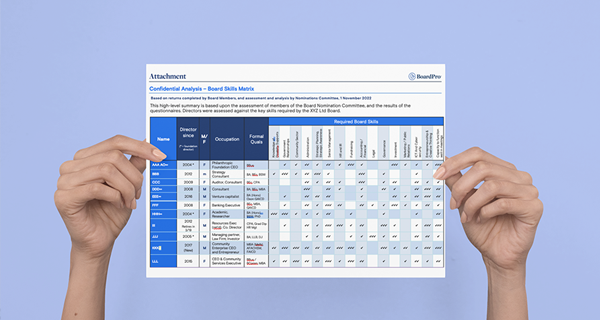
Download BoardPro's free board skills matrix template here
What does a board skills matrix record?
A simple skills matrix is a grid with directors running along one axis and the skills and attributes the board needs run along the other. Each cell captures a rating, usually on a simple scale, showing how much depth a given director brings to that area.
Most boards should to capture at least three categories of information:
- Technical and professional skills: finance and audit, legal, risk, digital and technology, HR and remuneration, marketing, and sector-specific expertise relevant to the organisation's activities.
- Governance experience: prior board or trustee roles, committee chairing experience, and familiarity with regulatory frameworks relevant to the sector.
- Personal attributes and diversity of thought: tenure, background, demographic diversity, and the behavioural qualities that shape how a director contributes in the room.
This third category is helpful in determining whether they can and will ask the hard questions, build consensus, or bring an alternative perspective.It is also the one most often gotten wrong. A grid full of ticked boxes for "finance experience" and "audit committee experience" can very easily produce a board where everyone thinks the same way and that’s dangerous. It can lead to a self-reinforcing bias and overconfidence in decisions that need to be interrogated further.
You can start with our matrix of board skills template, which sets out a working structure you can adapt to your board's size, sector and stage.
Why this matters for boards in the UK today
Boards can very easily drift into their current shape, through incumbency, personal networks or simple inertia. When they do they tend to end up with duplicated strengths and unaddressed blind spots.
For UK charities, for example, this can have very real consequences. A board of trustees that lacks financial literacy, safeguarding expertise, or digital understanding are exposed in ways that a well-constructed matrix would have flagged years earlier.
The same logic applies to emerging areas of oversight: a board with no one comfortable discussing environmental and social governance is unlikely to provide credible oversight of an ESG policy, regardless of how well-intentioned the rest of the board is.
Because of this, governance codes have moved from encouraging boards to think about diversity of thought to expecting them to evidence intentional composition.
- The UK Corporate Governance Code asks boards to maintain an appropriate combination of skills, experience and knowledge, and places responsibility for succession planning and composition squarely with the nomination committee.
- The Charity Governance Code carries a similar expectation for trustee boards.
- NCVO has been consistent in pushing the charity sector towards more deliberate, skills-led trustee recruitment rather than recruitment through existing networks alone.
- And the Chartered Governance Institute makes the same point: board composition should be designed, not accumulated.
A skills matrix is the practical mechanism that stops this from happening.
How to build a board skills matrix
Step 1: Define what the board needs
Start with the organisation's strategy and principal risks. List the eight to twelve competencies that genuinely matter for overseeing that strategy and mitigating those risks over the next three to five years. This usually includes governance and chairing experience, finance and audit, risk and resilience, digital and technology, people and remuneration, sector-specific knowledge, and, increasingly, ESG and sustainability oversight.
Resist the temptation to copy a generic list from another organisation's annual report; a matrix should be built for your board's specific risks.
Step 2: Score current directors honestly
Each director rates themselves, and is then discussed by the chair or nomination committee, against each competency. A simple 0 to 3 scale works well: 0 = no experience, 1 = working knowledge, 2 = strong experience, 3 = deep expertise.
The scoring conversation matters as much as the resulting numbers; it is often where a chair discovers that a skill everyone assumed was covered is actually held by only one person, who you might suddenly realise is due to retire soon.
Step 3: Map the gaps
Once every director is scored, the gaps become visible. Some will be obvious: no one with digital or cyber experience, for example, or a board that is financially strong but has no one with lived experience of the communities the organisation serves. Others are more subtle, such as a board where every director with risk experience joined within the same two-year window and will likely depart together.
Step 4: Turn the gaps into a recruitment and succession brief
Rather than recruiting the next trustee or non-executive director based on who happens to be available or well-connected, the board can write a role specification that names the exact competency gaps that need filling.
This is also the point where the distinction between the board's role and management's role becomes relevant; our guide on the board of directors versus the executive committee is useful context for boards clarifying where governance oversight ends and operational expertise begins.
Common mistakes boards make with a skills matrix
Not updating it. A matrix reflecting the board's composition from three years ago is a historical document, not a governance tool. It should be revisited annually, ideally alongside the board's own performance review.
- Scoring credentials instead of capability. A director who sat on an audit committee a decade ago is not automatically strong on current financial oversight. Ratings should reflect current, applied capability, not a résumé line.
- Treating it as a compliance exercise. A matrix produced purely to satisfy an annual report disclosure requirement, and then filed away, delivers none of the actual benefit. The value is in the conversation it forces about board composition.
- Ignoring behavioural fit. Two directors can hold identical technical qualifications and contribute completely differently in the room. A matrix that only measures credentials will miss this.
Connecting the skills matrix to the rest of board practice
A skills matrix should feed directly into how meetings are planned and run. A board with a documented digital skills gap should expect that gap to show up in how agenda items are framed and whether external expertise need to be brought in for this part of the meeting.
It should also inform how risk is overseen. A board that knows it is thin on cyber or financial risk expertise can use that knowledge to shape how its risk register is reviewed and who leads the discussion on each risk category.
And because good governance depends on decisions being properly recorded, not just made, strong minute-taking matters too; see our UK board meeting minutes template for what a defensible record of decision-making actually looks like.
The role of software in a skills-based board
BoardPro gives your skills matrix somewhere to live that isn't a dead file on a shared drive. Instead, upload the filled out skills matrix and securely share it with BoardPro so when it comes to board composition conversations or when when a nomination committee sits down to plan succession, everyone starts on the same page, with the skill gaps identified and everyone knowing what they’re searching for.
Download BoardPro's free board skills matrix template, and create your free BoardPro account to see how BoardPro helps you run more streamlined meetings, capture actions and decisions, and ensure good governance so your board can have more impact.

Share this
Board of Directors Induction: A Practical Guide and Checklist
/Blog-image-ceo-report-that-delights-the-board.jpg)
CEO Report Template: What UK Boards Need from Their Chief Executive