

Board Induction: What New Directors Need in Their First 12 Months
Add strategic value from your very first board meeting
A smarter way to induct, support, and empower new directors
A new director is exposed from the moment they're appointed—legally, practically, and in front of a board that's already watching how they contribute. Before they've read a single board pack, they're expected to understand the organisation's governance, its financial position, and their own legal obligations.
Good board induction isn't onboarding admin. It's risk mitigation and a governance obligation the board chair or governance committee owns from day one.
This page covers what a proper board induction pack should include, how BoardPro's Induction Insights for Directors program supports the first 12 months, and where mentoring and legal-duty awareness fit into the induction process.
What is Board Induction?
A well-run induction process gives a new board member the context to contribute from their first meeting, which is especially important as they join the board and become effective board members quickly rather than spending months catching up quietly.
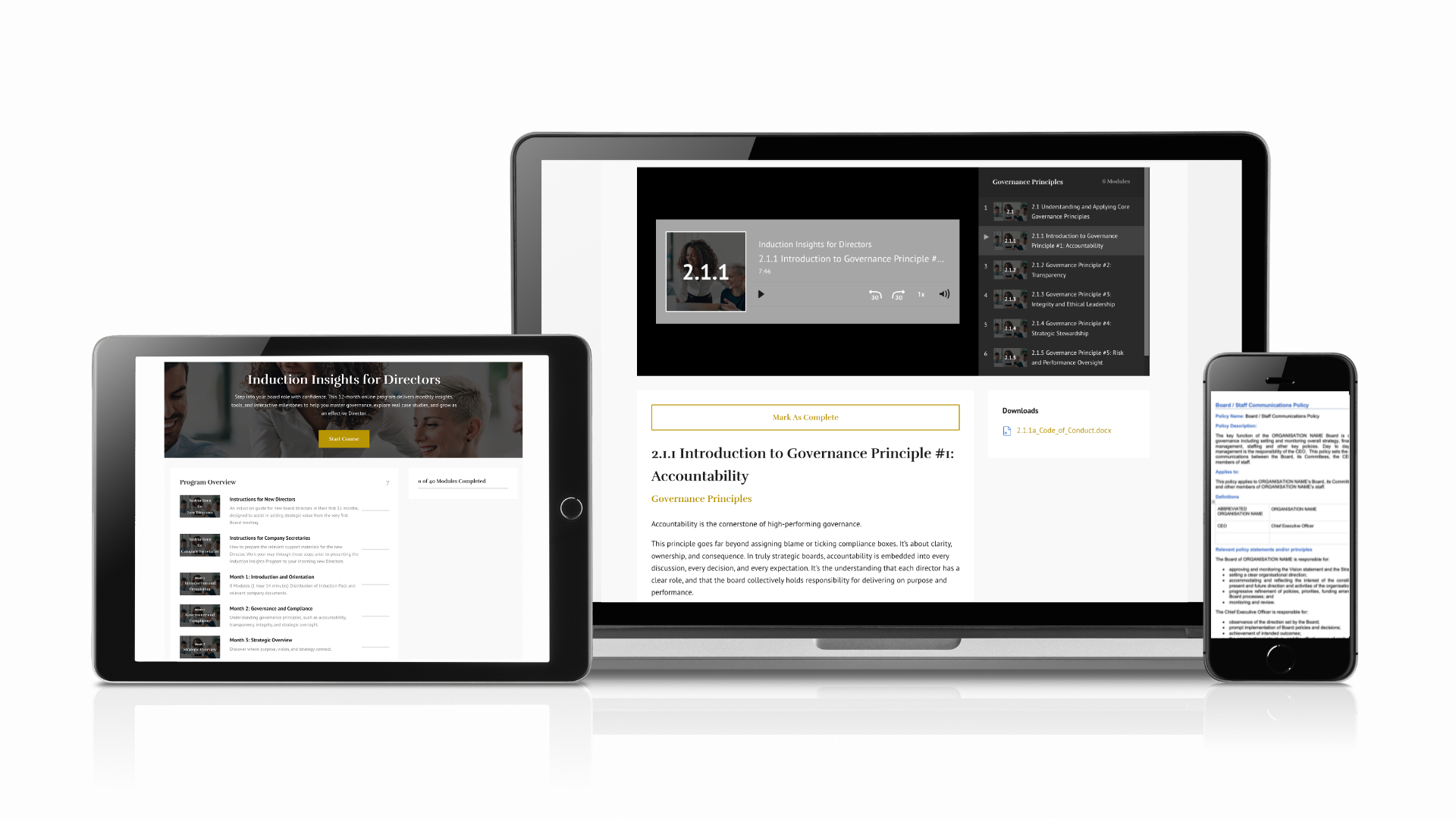
How the Induction Insights for Directors Program Works
Induction Insights for Directors is one structured way to deliver high value director insights, built from thousands of interviews with chairs, directors, and CEOs.
The program runs over 12 monthly modules, each with three components:
Expert content
Audio modules with transcripts, practical and conversational rather than academic.
Company Secretary Preparation
Clear guidance on what the Company Secretary prepares each month, so directors get the right information at the right time and to assist with coordinating materials and timing.
Questions and Actions
Reflection prompts and actions that turn passive listening into active induction. Directors have full access to every module and can move at their own pace.
Company Secretaries and new directors consistently name the downloadable templates and resources as one of the program's most valuable parts.
Access complimentary preview →
The 12 month Director Journey
Induction shouldn't wait for the next board cycle. It should begin almost immediately after a new director appointment, owned by the chair or governance/nominations committee, and run across three phases — a cadence consistent with the AICD's board effectiveness principles.
Months 1 to 5 Foundation: Building Confidence in Governance Essentials
Building the confidence, judgement, and boardroom understanding needed to contribute effectively and credibly from the outset, with early orientation clarifying the organisation's strategic direction.
Months 6 to 8 Integration: Deepen and Apply
Embedding governance into everyday practice through real experience, reflection, and the confidence to contribute in more complex board discussions.
Months 9 to 12 Mastery: Evolve and Lead
Refining directors into trusted contributors who strengthen board performance through mentorship and sustained, purposeful involvement.
Frequently Asked Questions
Board induction is the structured process of introducing a newly appointed director to an organisation's governance, strategy, legal duties, financial position, and decision making processes.
A good induction pack includes the constitution, strategic plan, board policies and code of conduct, financial reports, recent board papers and minutes, the interest register, a personlaised onboarding plan, and an induction checklist confirming everything has been provided; it can also serve as a summary of what has been supplied and what still needs attention.
Induction is typically owned by the board chair or the governance/nominations committee or company secretary, who manage the process and ensure the new director receives what they need on schedule, even if different departments assist with parts of the process.
Induction should begin almost immediately after the appointment—not delayed until the next board cycle or the new director's first meeting.
A structured induction typically runs across a new director's first 12 months, moving from foundational governance literacy through to confident, active contribution.
Mentoring pairs a new director with an experienced board member for informal, regular check-ins. It complements structured induction content by giving new directors somewhere to take questions a module can't answer.
Yes — BoardPro's AI Assistant reads a board's own documents to help new directors get up to speed faster, without replacing the human judgement that an induction program is there to build. The AI Assistant can help with strategic questioning and alerts to emerging risks and changes in business.
Induction is the first-12-months process of establishing governance literacy and context. Ongoing development continues after that foundation is set, building deeper strategic and sector-specific expertise. This program can also be used for ongoing director development.
BoardPro gives new directors immediate access to key governance documents including AI Assistant and provides a structured induction insights program to support new directors.
AI Governance Is Now Board Work
AI is no longer an operational issue.
Boards need visibility, policy, and assurance over how AI is being used, including by directors themselves.
The Real Opportunity Goes Beyond Summaries
Summarisation is just the starting point.
The real value of AI lies in its ability to:
- Interrogate complex board material
- Surface patterns over time
- Strengthen challenge and decision-making
Used well, AI doesn’t replace judgement.
It sharpens it.
Not All AI Is Equal
There is a critical difference between:
- Ad hoc use of public AI tools
- AI embedded within a secure, governance-focused environment
The risk profile is not the same.
And boards need to understand that distinction.
What Our Customers Say on G2