
AI Governance Pulse: A Benchmark Report
AI is in the room. The governance of AI isn’t, yet.
485 directors, executives, and governance professionals across Australia, New Zealand, and beyond shared their views on where AI governance stands in 2026
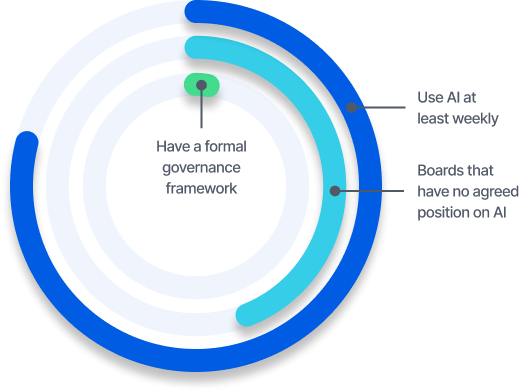
Individually, most governance professionals are already active users of AI. Nearly eight in ten use AI tools at least weekly — not just for drafting and admin, but for research, knowledge-building, and meeting preparation.
Organisationally, AI is widespread but largely invisible to leadership. At the board level, the gap is most pronounced: almost half have no agreed position on AI, and only 2% have a formal governance framework with clear accountability and regular reporting.
The challenge for boards in 2026 isn't AI adoption — it's AI governance.
Get your free copy
The three numbers that define the governance gap
79% use AI at least weekly
44% of boards have no agreed position on AI
2% have a formal governance framework
What this report covers
Benchmarks across three levels of AI governance
This report is organised across three levels — personal use, organisational adoption, and board governance. Knowing where you sit across all three is the starting point for knowing what to do next.
The personal adoption of AI for governance work
How governance professionals are already using AI — and why adoption is running ahead of confidence.
AI adoption at the organisational level
Where AI is being used, what governance measures are in place, and the significant blind spots most leaders don't yet know they have.
The state of AI governance in the boardroom
Benchmarks across board discussion, agreed positions, policy maturity, management reporting, and risk awareness — with sector comparisons.
What's inside
In this report you’ll find:
- Research data from 485 directors, chairs, CEOs, and governance professionals — not anecdote, but benchmark
- Sector comparison between not-for-profit and commercial organisations
- Real quotes from governance leaders on what they're grappling with — candid and unfiltered
- Three practical steps every board can take in 2026

AI Governance Is Now Board Work
AI is no longer an operational issue.
Boards need visibility, policy, and assurance over how AI is being used, including by directors themselves.
The Real Opportunity Goes Beyond Summaries
Summarisation is just the starting point.
The real value of AI lies in its ability to:
- Interrogate complex board material
- Surface patterns over time
- Strengthen challenge and decision-making
Used well, AI doesn’t replace judgement.
It sharpens it.
Not All AI Is Equal
There is a critical difference between:
- Ad hoc use of public AI tools
- AI embedded within a secure, governance-focused environment
The risk profile is not the same.
And boards need to understand that distinction.
Why it matters
The governance gap is real — and it is widening
Boards in 2026 have the responsibility of overseeing AI risk while simultaneously developing their own understanding of what that requires. AI is already shaping how organisations operate, and how boards will be judged on their oversight of it.
-
41% of organisations have staff using AI with no oversight
-
75% receive AI risk reporting ad hoc — or never
-
29% have no AI governance measures in place
Real voices from the boardroom
"We don't know what we don't know, and hence we can't see what is happening. Even if we could see it, I'm not sure we would know what to do anyway."
Director/Trustee/Non-Executive Director
Health/Social services organisation, Australia
"The board has approved AI on the assurance of governance, cultural safety, and clinical oversight. On the ground, ungoverned AI use is already happening, the governance scaffolding is still in draft."
Board Secretary/Governance Professional
Charity/Not-for-profit, New Zealand
"Shadow AI use is something that should have more concern at a Board level. When you work with clients, any information that is fed into unsanctioned AI agents or chatbots is a huge risk."
Board Secretary/Governance Professional
Charity/Not-for-profit, Australia
"Doing more with less in a not-for-profit is critical so the opportunity is productivity and eliminating administrative burden so we can serve our participants with more time."
Board Chair
Charity/Not-for-profit, Australia