

Try for Free Login

Free AI board governance whitepaper: a practical guide for directors

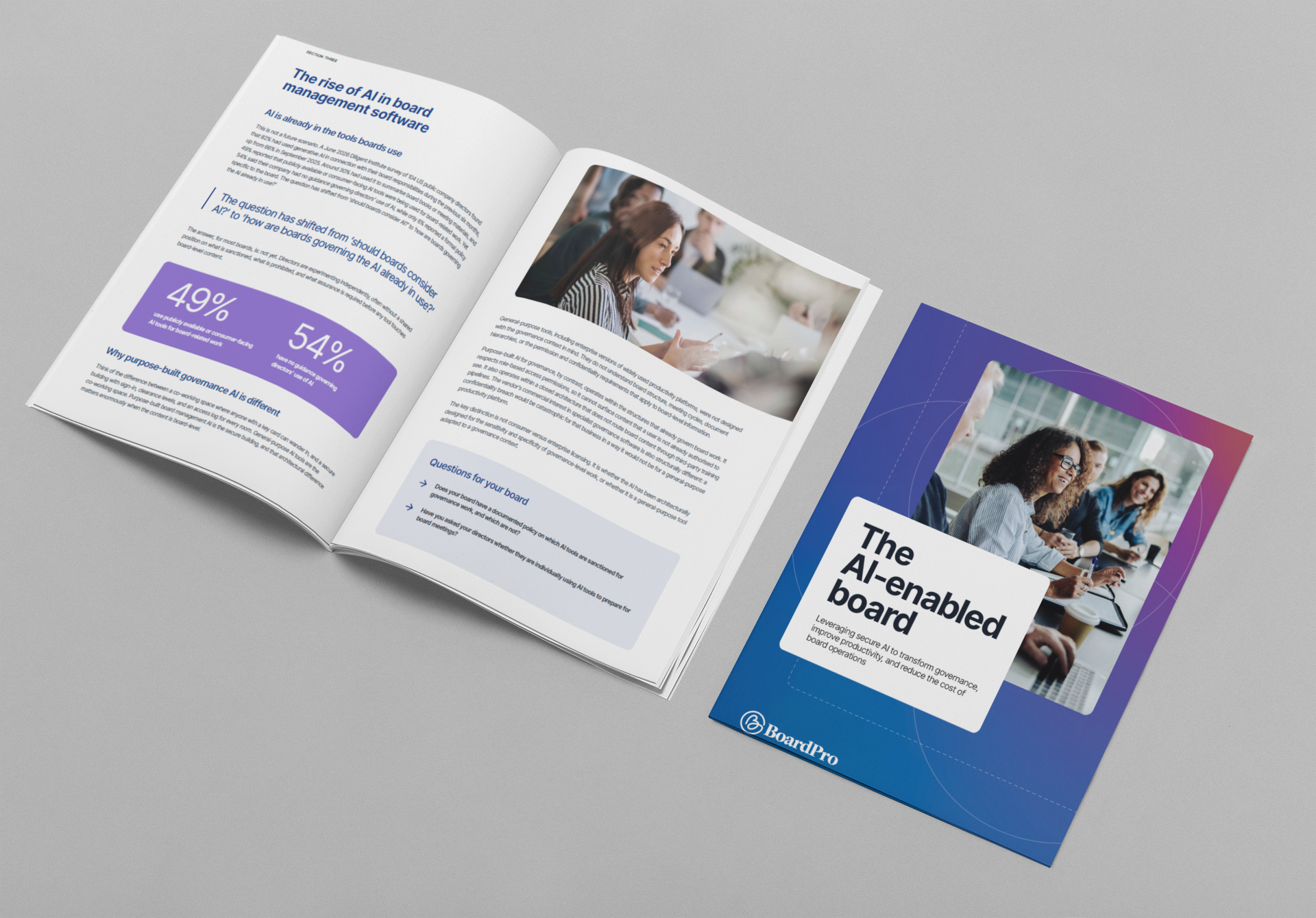
The AI-enabled board: using secure AI to strengthen governance, improve productivity, and reduce the cost of board operations

For directors, chairs, and executives navigating the real risks and opportunities of AI in governance

Get your free copy

AI is already in your boardroom. The problem is, it’s not being governed.

Right now, directors are using AI tools with your board papers. Yet most boards have no policy on AI use, no visibility into the tools being used, and no framework for managing risk. This is not a technology problem. It is a governance problem — and this free whitepaper shows directors how to solve it.

What is AI board governance?

AI board governance is how your board oversees the use of artificial intelligence across your organisation, by everyone, including directors. It means having visibility of the AI tools in use, a policy on how they're used, and assurance that sensitive board material is protected — so someone is accountable when an AI-assisted decision or record reaches the board.

Executive summary

Most directors already use AI tools such as ChatGPT, Copilot, and Gemini for board work, but few have a policy governing that use. In BoardPro's AI Governance Pulse 2026, 79% of respondents used AI weekly, yet 44% of boards had no agreed position on AI.

This matters because board documents are not ordinary workplace content; they include strategic plans, legal advice, executive performance data, and commercially confidential financials. And while privacy regulators in Australia and New Zealand have issued explicit guidance against entering sensitive information into publicly available AI tools, it continues to happen.

This whitepaper covers:

  • How boards need visibility, policy, and assurance over the use of AI across their organisation, by everyone, including directors.
  • How, when used with discipline, AI can strengthen governance practice — not only summarising information, but also interrogating complex board material, surfacing patterns over time, and supporting higher-quality challenge.
  • How the ideal tool embeds AI within a controlled, purpose-built governance environment with clear data handling, permissions, and auditability.

Get your free copy

No cost, no obligation. Enter your details and we'll send the whitepaper straight to your inbox as a PDF. 


AI enabled board whitepaper to download
Download the whitepaper to learn which AI tools are suitable for board-level content, the risks involved, and the safeguards for using them.

What's inside the whitepaper?

1

AI governance is now board work

AI oversight belongs at board level, not just with management, given its impact on strategy, operations and risk. This section explains why boards need visibility, policy and assurance over how AI is used across the organisation — including by directors themselves — and what happens when that oversight is missing.

2

The real opportunity goes beyond summaries

Summarising a board pack is the easy part. Used with discipline, AI can help directors interrogate complex material, spot patterns across past meetings, and ask sharper questions in the room. This section sets out what that looks like in practice, and where the line sits between AI supporting judgement and replacing it.

3

Not all AI is equal

Using a public AI tool on an ad hoc basis is very different from using AI inside a secure, purpose-built governance environment with clear data handling, permissions and audit trails. The risk profile isn't the same, and this section explains why that matters for anything touching sensitive board material.

1

AI Governance Is Now Board Work

AI is no longer an operational issue.
Boards need visibility, policy, and assurance over how AI is being used, including by directors themselves.

2

The Real Opportunity Goes Beyond Summaries

Summarisation is just the starting point.

The real value of AI lies in its ability to:

  • Interrogate complex board material
  • Surface patterns over time
  • Strengthen challenge and decision-making

Used well, AI doesn’t replace judgement.
It sharpens it. 

3

Not All AI Is Equal

There is a critical difference between:

  • Ad hoc use of public AI tools
  • AI embedded within a secure, governance-focused environment

The risk profile is not the same.
And boards need to understand that distinction.

You'll also find ...

  • Research from professional bodies on how organisations are really using AI
  • Questions to ask at your board table to start the conversation about AI use and risk
  • Practical use cases that show how directors can use AI safely

template images in-line

Why AI governance matters for boards

Board materials are some of the most sensitive information any organisation holds:

  • Strategic plans
  • Legal advice
  • Executive performance data
  • Commercially sensitive financials

Privacy regulators in Australia and New Zealand have already warned against entering sensitive information into public AI tools. Yet in many boards it's happening informally, invisibly and without control. The whitepaper gives directors, chairs, executives and governance professionals practical guidelines for using AI safely.


ai-board-governance

Meet the experts

Helen-van-Orton

Helen van Orton

Helen van Orton is the founder of Directorly and one of New Zealand’s leading voices at the intersection of governance and artificial intelligence. Through Directorly, she works with boards and executive teams across New Zealand and internationally to build AI fluency and strengthen governance capability, including through her senior leaders programme, The AI Empowered Leader. She is a current director of Co-operative Bank, Co-operative Life, and Centrix Group, with a governance career spanning former chair roles at the HR Institute of New Zealand and Answers Services Ltd, and directorships across financial services, retail, and technology sectors. Her executive career built deep experience in digital transformation, marketing, and customer experience. She is a graduate of the IoD’s Advanced Director Programme, a mentor in the Te Ara Tāwhaki governance programme, leads BoardPro’s AI Masterclass, and speaks regularly for BoardPro alongside Alexie on AI and governance. She is a contributor to BoardRoom magazine and the IoD and Govern 365 podcasts.

Alexie-O’Brien

Alexie O’Brien

Alexie O'Brien is the Director of Leadership Academy.ai and works at the intersection of AI, leadership, and board effectiveness. A former retail and financial services executive with senior roles at lululemon and Rip Curl, she brings practical commercial experience to her governance and advisory work. Alexie is a current board director, a Graduate of the Australian Institute of Company Directors, and holds qualifications in Commerce and professional certifications in coaching, DISC, and Emergenetics profiling.
Through her consultancy and Leadership Academy.ai, Alexie works with boards and executive teams across Australia, New Zealand, and internationally to build AI fluency, strengthen governance capability, and navigate the practical challenges of responsible AI adoption. She specialises in helping organisations move from AI curiosity to confident, governed use.


How to use the whitepaper with your board

  1. Download it and read it yourself first. It takes about fifteen minutes.
  2. Add "AI governance" as a stand-alone item on your next board agenda, rather than folding it into general business.
  3. Use the whitepaper's questions as discussion prompts: which AI tools are already in use — by directors, the management team and staff — and for what.
  4. Agree one simple rule as a starting point, such as no sensitive board material going into a public AI tool. Build from there towards a full AI policy.
  5. Assign someone to own the topic and bring an update to the following meeting.

You don't need a finished AI policy before your first conversation. You need the conversation.

AI board governance frequently asked questions

What is AI board governance?

AI board governance is the way a board oversees how AI is used, both by directors themselves and across the wider organisation. It covers what data AI tools can see, who checks AI-generated content before it's acted on, and who is accountable if something goes wrong.

Do directors already use AI tools like ChatGPT?

Yes, and often without a policy. In BoardPro's AI Governance Pulse 2026, 79% of respondents used AI weekly, but 44% of boards had no agreed position on AI and only 2% had a formal framework. That governance gap between use and oversight is what this whitepaper addresses.

Is it safe to put board papers into a public AI tool?

Generally, no. Privacy regulators in Australia and New Zealand have warned against entering sensitive information into publicly available AI tools, and board papers often include strategic plans, legal advice and confidential financials. The whitepaper explains a safer alternative: AI used inside a secure environment with clear data handling and audit trails.

Does AI replace a director's judgement?

No. Used well, AI supports judgement rather than replacing it. It can help summarise material, surface patterns across past meetings and prepare sharper questions, but the decision and the accountability for it stay with the director. The whitepaper sets out where that line sits.

Who should read this whitepaper?

Directors, board chairs and executives who want a practical, non-technical view of AI governance. You don't need any AI background, and it's written to support a first board conversation rather than assume one has already happened.

How long does it take to read?

About fifteen minutes. It includes a short section on bringing it into your next board meeting, so it works as a discussion prompt rather than something filed away.

Govern AI use in a secure board environment

The whitepaper draws a clear line between public AI tools and AI built into a secure governance environment. BoardPro AI puts better governance intelligence where it belongs — with the humans who are accountable for it. Directors spend less time wrangling papers and more time on the decisions that shape outcomes for the people and communities your organisation serves.

Download the whitepaper, then try BoardPro free for 30 days, no credit card needed.

#1 Highest User Adoption Board Management Software

What Our Customers Say on G2

"We use BoardPro for all our meetings and not only is it easy for us, it's proven to be easy to navigate with our not so tech savvy members as well! It's organized, it looks amazing when auditors need to confirm our minutes, and it's just THAT useful. All around amazing!"
Ericka P
Secretary, Small-Business (50 or fewer emp.)
"This is an excellent board tool. Mobility, no paper, ease of navigation, brilliant note options. The ability to quickly find previous papers and minutes is also very helpful for accountability."
Paul M
Chairman, Mid-Market (51-1000 emp.)
"BoardPro has proven itself indispensable. The structured approach makes it easy to compile agendas and Board packs and then use this same structure for creating well-organised minutes. Being able to search for previous decisions and minutes, as well as easily keep tabs on actions is fantastic. The reminders that BoardPro sends out keep everyone on task, without the Board Secretary needing to be too involved."
Virginia C
Board Secretary, Mid-Market (51-1000 emp.)
Staying at the top of your professional game! In the past, preparations for Board meetings were a nightmare as there were always literally mountains of paperwork to prepare, photocopy and share with Board members. This was such a tedious task, not to mention not great for the environment. Now, with BoardPro, all meeting documents are virtual and there is no longer any need for photocopying and wasting so much paper. This has cut our meeting cost down significantly.
Arieta D
Human Resource & Compliance, Small-Business (50 or fewer emp.)
Completely changed our board meetings! The software drastically improves organization of documents and communication before and after meetings. It gives us a central place for recording and reviewing minutes. We use the action items feature extensively, which automates everything so nothing slips through the cracks. The technical support is impressive.
Peter K
President, Mid-Market (51-1000 emp.)