

.png?width=40&height=40&name=Untitled%20design%20(29).png)
Megan Motto OAM is the CEO of Motto Advisory, where she leads governance reviews and strategy work for organisations across Australia, with a particular focus on the not-for-profit sector. A former CEO of the Governance Institute of Australia (GIA), she brings more than 25 years experience across professional associations, public policy, and governance.
Megan is delivering the opening keynote AI: our future in today's changed workforce at BoardPro's Governing with Impact in the New AI World roadshow this October.
Megan is drawn to work with a service ethos, from her early career as a teacher to her work in the built-environment sector with Consult Australia, and the GIA. With Motto Advisory, she is enjoying what she calls her ‘portfolio career’, comprising interim executive work, strategy facilitation, and governance reviews.
A career grounded in service
Megan traces her instinct for service work back to the classroom, and the framing has stuck with her across every role since.
“As a teacher, your aspiration is not to be the best yourself, it's to lift your students to success.”
That same instinct is what drew her to associations, where the job is to lift members — companies or individuals — toward their own success, and to improve the wider landscape they operate in. Across two decades in association leadership, she has applied one consistent test to policy work: does it serve the Australian community first, ahead of any single company or profession?
“I've unashamedly maintained that narrative in every role that I've ever taken; that our advocacy positions have to be the best thing for the Australian community.”
It is a demanding test, and she is clear it has to be a real one — not, in her words, a “very thin, sinewy thread” drawn to justify a position after the fact.
How infrastructure began the journey to governance
Megan's interest in governance did not start with a governance job. It started with a question about infrastructure. Working with engineers on Australia's infrastructure priorities, she noticed that the national “strategy” was little more than a wish list of favoured projects — one per state — with no visible framework behind the choices.
“Who decided on this wish list? What process have these projects gone through? Where is the governance around that decision?”
The work that followed, including the case for a strong, independent Infrastructure Australia, taught her an essential element of governance.
“It wasn't about the merit of a particular project, it was about the decision-making framework to validate.”
That distinction became the throughline of her career. At the GIA, Megan went on to rebuild the education offering, linking short courses, micro-credentials, and postgraduate study through a single capability framework, and took the courses herself, which, by her own account, made her a demanding student for her own staff.
“I'm a governance nerd. I believe in the power of governance to not only tick the boxes to comply with your legislative and regulatory requirements, but to help you perform at your best.”
The three real pressures facing Australia's not-for-profits
Ask Megan about Australia's not-for-profit sector and she describes an image.
“The not-for-profit community in Australia, you know, like any business community, looks a little bit like the Comet with the big head at the front and the long tail at the end.”
A small number of large, well-resourced charities can attract the top of the corporate community to serve pro bono. The long tail — the roughly 96% that are very small — face a harder set of pressures, and three of them stand out in Megan's account.
The first is a long, slow move away from giving time. “People would prefer to give money these days than time,” she says, a shift visible across volunteering, membership, and even religious affiliation over several decades.
She is quick to reject the easy conclusion that follows, though. Rather than a disengaged younger generation, she sees the opposite, on one condition: “I find the young people of today are very committed, but you’ve got to create the right emotional connection.”
The second pressure is a widening gap between what small organisations can deliver and what their members now expect.
“There is a really big mismatch between the level and speed of professionalisation of many of these very small charities, clubs and associations.”
Members who are dual-income professionals expect to pay by card, receive proper invoices, and see policies, insurance, and codes of conduct in place, while the volunteers running the organisation are being asked to lift their governance faster than they can staff it.
The third is subtler, and specific to purpose-led organisations: the passion that powers a cause can also cloud the governance of it.
“That passion can be a double-edged sword in the governance world. Comes with benefits, but it also comes with complications because people blur the lines between governance and management.”
Why experience is what makes AI safe to use
Those pressures already stretch small boards to their limit — and now AI has landed on top of them, at a pace that tests every board, large or small. It is the theme of Megan's roadshow keynote, and the one she returns to most readily: what that speed asks of the people governing it.
“I think the biggest challenge with AI is the pace of change.”
Megan is an enthusiastic user of AI, and she is candid about why she thinks she uses it well — and it is not technical skill.
“My years of experience help me to know how to prompt it in the first place, how to think through the ethical frameworks of my use and how to critically analyse what comes out at the other end.”
That observation carries a warning. If judgement is what makes AI safe to use, what happens to the people entering the workforce without the years of experience that build it? Her answer is not to slow the technology down but to change how organisations train.
“Things that we used to think of as soft skills are actually the hard skills.”
Creativity, analytical thinking, negotiation, working with people, the capabilities long dismissed as “soft” are, in Megan's view, exactly the ones AI cannot supply and the ones experience quietly teaches. The task for thinking organisations, she argues, is to make that teaching deliberate rather than incidental.
“We need to think about how to codify the teaching of those capabilities in workplaces so that we've got a generation that is still learning side by side in using the AI rather than just using it blindly and bypassing the learning process.”
Her keynote will offer directors a practical, reassuring way to think about governing AI, one built on frameworks leaders already understand, rather than on fear of the technology itself.
The value of governance experience when everything is changing
For leaders, the daunting part of AI is not any single decision but the number of them at once: workforce, culture, processes, business model, and governance all need rethinking together, and the job is to do that and still come out ahead.
BoardPro's own research points to the gap around AI use that Megan describes: across 485 boards in New Zealand, Australia, and beyond, most are using AI weekly, yet only a small fraction have an agreed position on how to govern it. The technology has moved faster than the frameworks around it, which is precisely where experienced governance judgement earns its keep.
Better-run boards make AI decisions that hold up, and that is where governance turns into real-world impact — the difference felt outside the boardroom, in the communities these organisations serve.
Learn more: hear Megan at Governing with Impact in the New AI World
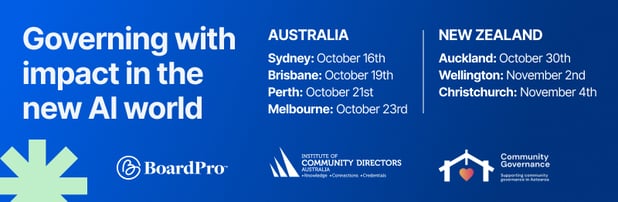
Megan Motto delivers the opening keynote, AI: our future in today's changed workforce, at BoardPro's Roadshow — cutting through the fear and the hype with practical, actionable strategies leaders can use straight away.
The roadshow runs across four Australian and three New Zealand cities this October and November… save with early-bird tickets when you register before 30 September.
Choose your city and register here

Share this

Profile: Rose Hiha-Agnew of Community Governance Aotearoa

Introducing Simon Telfer - Another governance expert supporting the BoardPro community
.png)